Non-existent suppliers inserted into payment pipelines.
Corruption Reduction Simulations
Stress-test corruption controls before they meet real money.
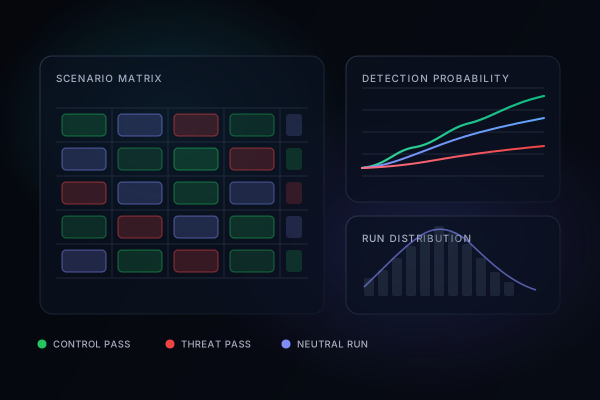
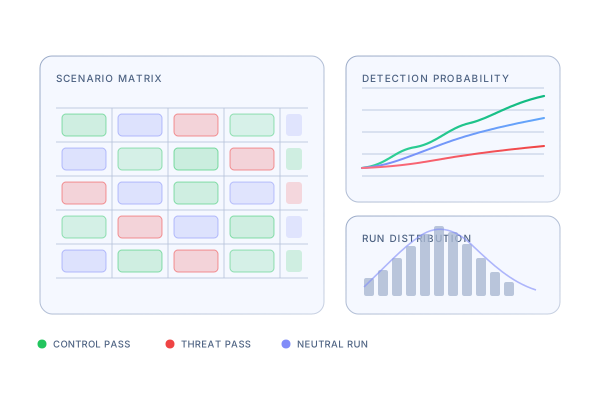
Runs score prevention, detection, and operator burden as attacks get more coordinated.
Recall Target 0.85
0.85
0.85False Positive Cap 0.08
0.08
0.08Batch Runs100/scenario
100/scenarioThreat Model
Canonical attack scenarios
Each scenario fixes the seed, attacker profile, ground truth, and the band we expect metrics to land in.
Invoice fragmentation to bypass approval thresholds.
Coordinated signers exploiting weak segregation of duties.
Exception pathways used to skip controls.
Repeated hidden transfer loops around procurement events.
Specification manipulation to pre-select favored vendors.
Experiment Matrix
Control stacks compared to baseline
Each variant adds one layer of control so we can see effect size and the latency and review cost it buys.
Legacy Opaque Flow
Variant BaselineMinimal transparency and limited post-event auditability.
- No deterministic chain reconstruction
- Higher forensic workload
- Used as comparison anchor only