Participation Dynamics
Stable participation, decay patterns, mobilization spikes, and strategic abstention behavior.
Electoral Automation
The track models blockchain-backed electoral automation where confidence updates each epoch instead of only on a multi-year cycle.
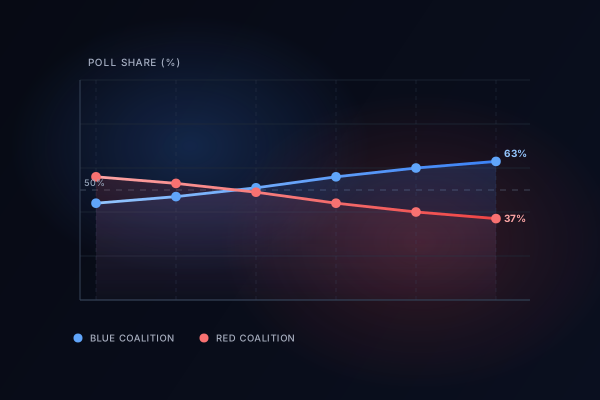
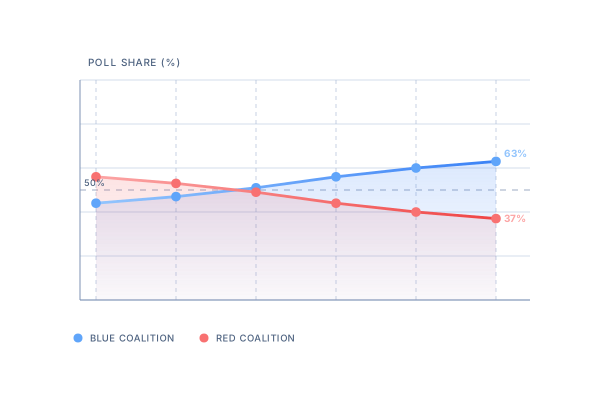
 WeeklySimulation only
Protocol Layers
Identity, ballots, casting, finality, and audit sit in separate layers so one weak spot cannot own the whole process and challenges stay available.
Eligibility checks run per epoch with auditable updates, anti-duplication controls, and challenge windows for contested records.
Ballot objects are versioned, signed, and committed before voting windows open to prevent silent rule drift.
Voters receive verifiable receipts while preserving private ballot content and limiting coercion vectors.
Tally finalization is deterministic and reproducible with explicit pre-finality dispute hooks.
Independent actors can trigger proof-based recount and consistency checks under protocol-defined conditions.
Simulation Dimensions
Runs mix voter behavior, hostile actions, and protocol response, then read stability and perceived legitimacy from the traces.
Stable participation, decay patterns, mobilization spikes, and strategic abstention behavior.
Misinformation surges, identity fraud attempts, vote buying pressure, and availability attacks.
Legitimacy volatility, turnover frequency, policy continuity balance, and administrative overhead.
Constitutional hard bounds, oversight quorum, transparent rule updates, and anti-capture controls.
Experiment Matrix
We line up fixed-cycle and continuous designs under the same participation shocks, capture plays, and swings in mandate support.
Single large election cycle with discrete mandate transitions.