
Masivotech

Masivotech

Verifiable governancethrough auditable systems.

We turn governance proposals into models you can run: public-money traceability, corruption controls under attack, and electoral mechanics, each with stated metrics and limits.

Governance can be engineered,
tested, and improved.

Current democratic and economic systems carry structural limitations: opaque public spending, undetected corruption patterns, and electoral cycles disconnected from real-time legitimacy. We believe AI and blockchain can address these - not by replacing institutions, but by making them verifiable.

01

Research-first approach

Every proposal is modeled and simulated before any public claim. Hypotheses are labeled separately from validated outcomes.

02

Safety by design

Prevent AI systems from translating corrupt or low-quality ideas into governance decisions. Human override and auditability are non-negotiable.

03

Marketplace of ideas

Evolving guardrails to guarantee that no single ideology ever captures the agenda, empowering instead an open system where stronger proposals are allocated the same resources for an equal chance to win on results.

Two hard constraints,
one executable thesis

If we want faster progress in the physical world, institutions have to make better decisions faster. If we want those decisions to stay legitimate, power has to stay observable and contestable. Participants of the system need a real-time, clear view over the mistakes of the current system and an equal voice to spark the right course of action so those mistakes are fixed with no artificial delay.

Constraint 01

Atoms vs. Bits

"We wanted flying cars, instead we got 140 characters."

Peter Thiel

The world of bits ships fast as opposed to institutional systems that get stuck continuously in artificially created problems such as permits, budgets, and liability chains, which are often rooted in the barrier of information exchange between the physical and the digital world. When atoms lag bits, the binding constraint is often how fast governance can commit and reverse decisions, not how fast you can prototype.

The Institutional Compiler

Use AI to compile policy intent into executable rules, run simulations before deployment, and expose who absorbs risk before public rollout.
Constraint 02

Power Corrupts

"The biggest lie in modern American politics is that power doesn't corrupt."

Raymond Reddington, The Blacklist

Original source: Lord Acton (1887), "Power tends to corrupt, and absolute power corrupts absolutely."

Where discretion is hidden, corruption drifts in. AI that decides without traces, third-party review, or appeals does not fix the issue either, it may in fact widen the blast radius.

Capture Resistance by Default

Every decision engine should be explainable, reviewable by independent parties, and reversible through a visible appeal path, otherwise efficiency becomes a corruption accelerator.

Masivotech thesis

Build governance systems that are executable like software and accountable like constitutional design.

Three coordinated
research streams

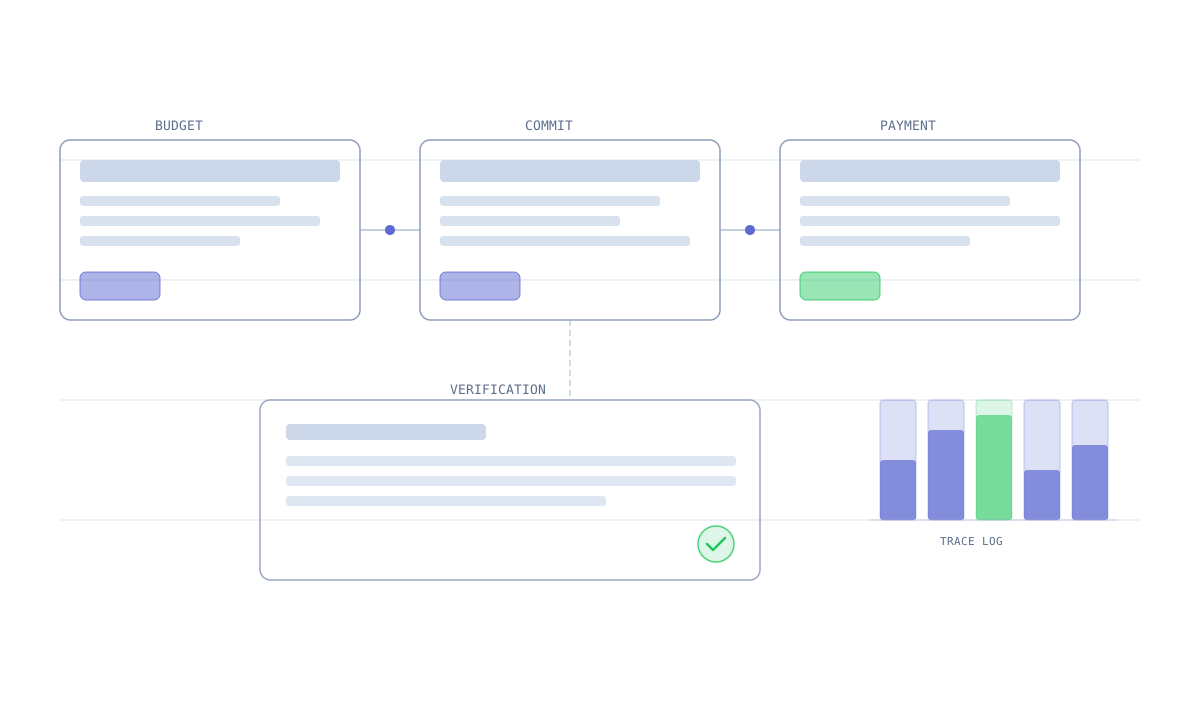
Each stream has low-level architecture, simulation plan, and acceptance criteria. Outputs are designed to be testable and fixable.

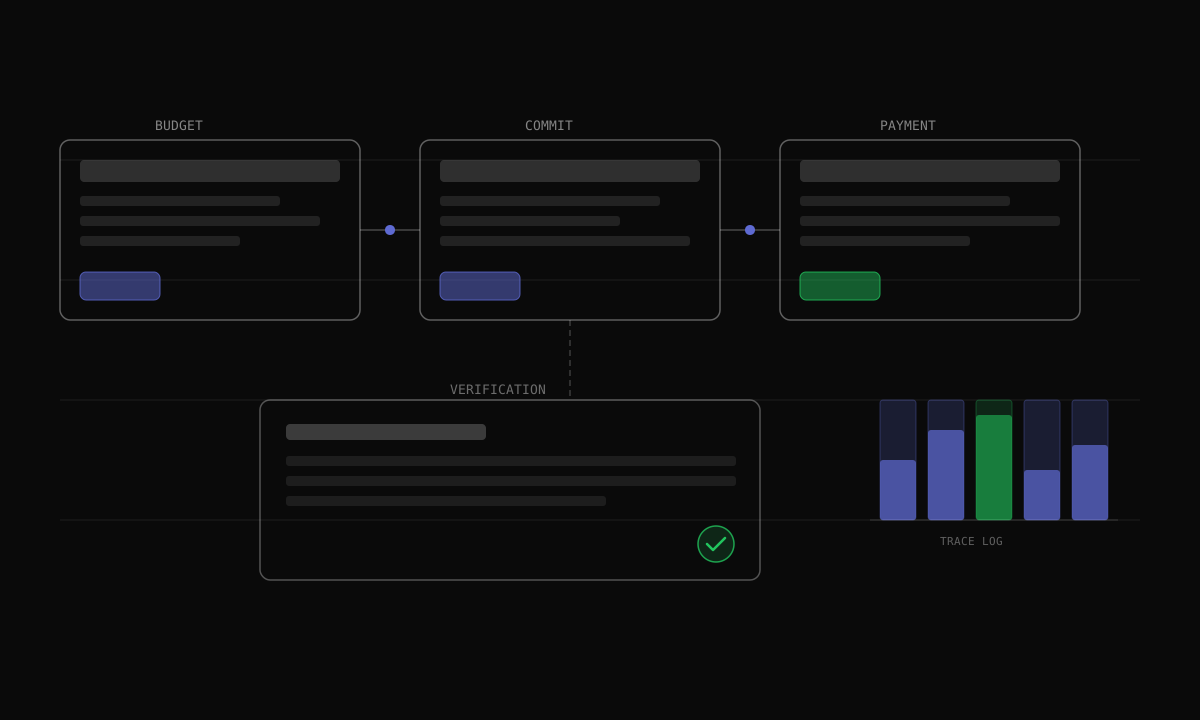
End-to-end transaction traceability diagramEnd-to-end transaction traceability diagram

Measurable outcomes

Targets are fixed up front (examples below). Runs are scored against them so comparisons stay honest.

Traceability99.9%
Recall0.85
P95<5s

Visualize the system

Diagrams and sims carry the same claims as the specs. They are there to show data flow, failure modes, and where humans step in.

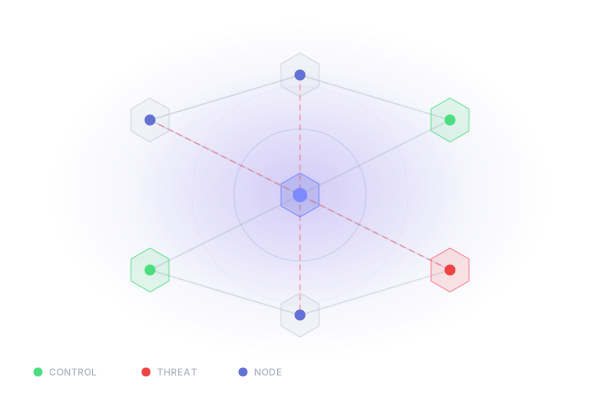
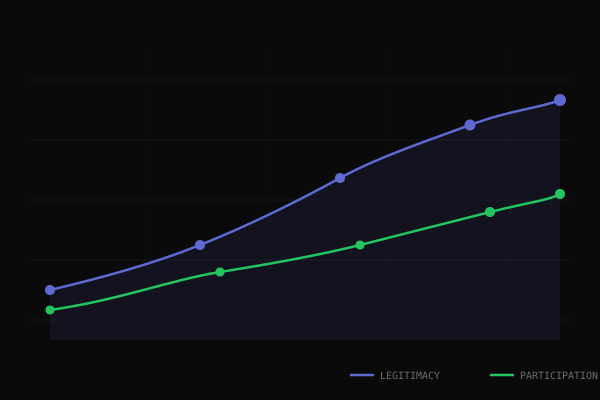
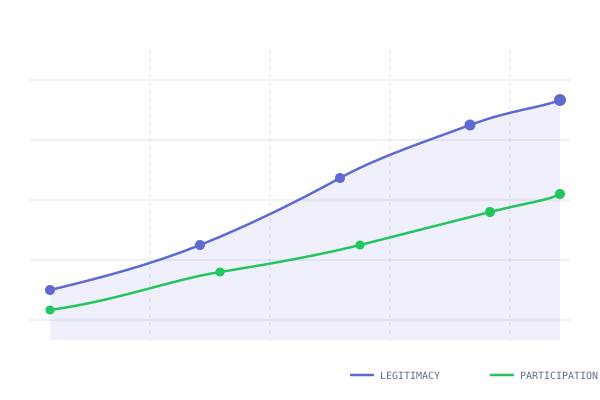
Corruption simulation pathwaysContinuous voting and legitimacy signalsContinuous voting and legitimacy signals

Reproducible research

Experiments are designed upfront to be reproducible, with code, data, and methods documented, reachable and variables adjustable.

Method before messaging

The lab claims only what can be reproduced. Every proposal must include assumptions, experiment design, confidence intervals, and explicit limitations.

Built for research.
Tested in simulation.

Review our frameworks, compare simulations, or contribute to the research.